

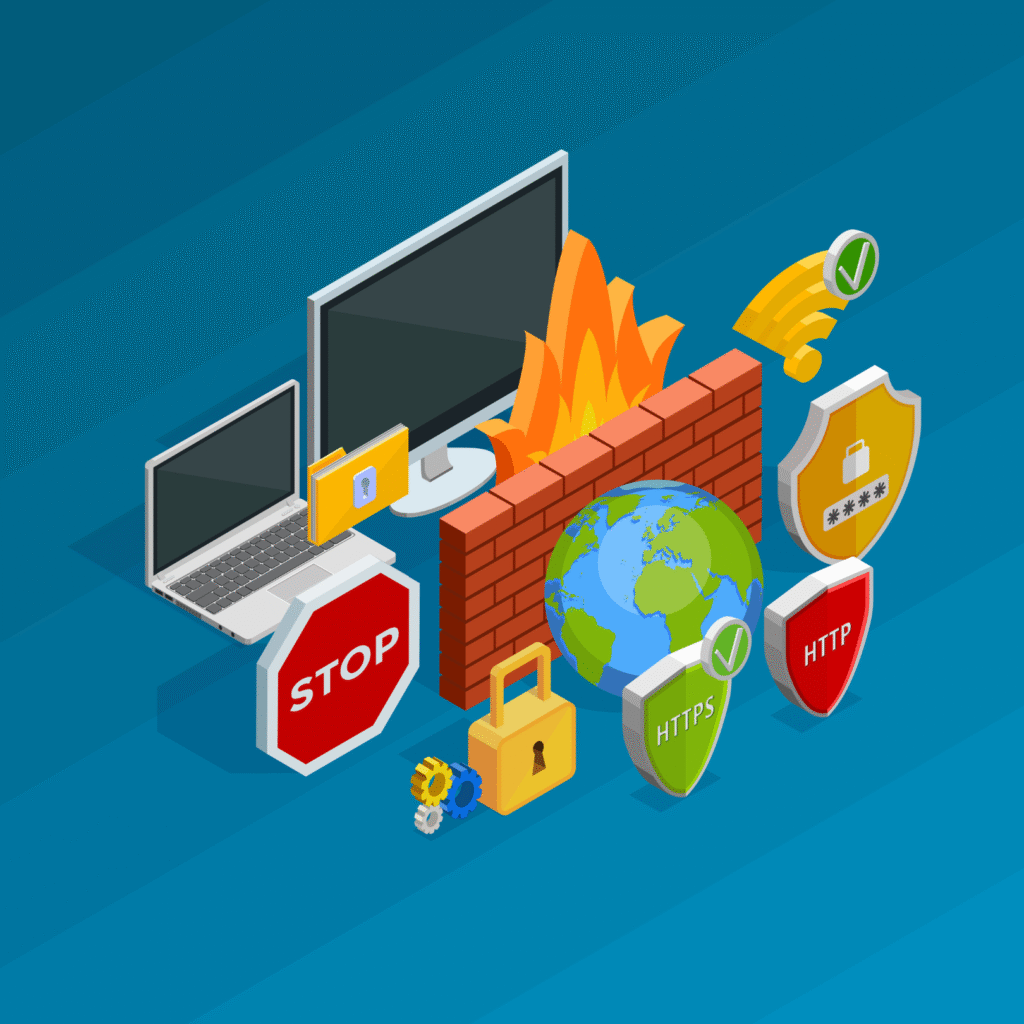
International reports show that companies are facing an alarming increase in cyberattacks. In 2025, more than 7.5 million security incidents were recorded worldwide, according to the Cybersecurity Intelligence Report.
In the United States, ransomware accounts for about 41% of all corporate attacks, while in the United Kingdom, 43% of organizations report having suffered a breach in the last 12 months. These figures reinforce a crucial point: well-configured firewalls are more than technical barriers; they are the foundation of digital resilience.
Failing to implement effective firewall policies can open loopholes that compromise data, operations, and even a brand’s reputation. Below, we explore best practices for structuring, maintaining, and optimizing corporate firewall policies that truly protect your infrastructure.
What is the role of a firewall in corporate security?
A firewall is a network traffic control mechanism that acts as a barrier between internal and external environments, analyzing each data packet to decide whether it should be allowed or blocked.
More than just a connection blocker, it is an access governance tool, essential for preventing intrusions, lateral movements, and data leaks.
The main types of firewalls include:
- Network Firewall (Perimeter): monitors traffic between internal and external networks.
- Application Firewall (WAF): protects web applications against injection attacks and vulnerability exploitation.
- Next-Generation Firewall (NGFW): offers deep packet inspection, threat detection, application control, and integration with SIEM and IDS/IPS systems.
The choice and proper configuration depend on the size of the infrastructure, the complexity of the network, and the level of exposure to external risks.
After all, what are firewall policies and why are they so essential today?
Firewall policies are the set of rules that guide firewall behavior. They define what can (or cannot) travel on the network and translate corporate security guidelines into practical actions. An effective policy should include:
- Access criteria: who can access what, and under what conditions.
- Authentication and auditing: logging of actions, changes, and access attempts.
- Continuous monitoring: analysis of logs and traffic reports.
Without well-structured policies, firewalls operate with overly broad permissions, which increases the attack surface and makes incident control difficult.
How to apply a firewall correctly? See the best implementation practices:
Configuring a firewall is not just about turning on the equipment or applying generic rules. The effectiveness of a firewall depends directly on a well-planned strategy, aligned with the company’s needs and global security best practices. Here are the main ones:
-
Apply the principle of least privilege
Each rule should only allow traffic that is strictly necessary for operations. This practice reduces the risk of misuse and minimizes the impact in case of compromise.
-
Structure security zones
Implement network segmentation by creating zones (such as DMZ, internal network, and visitor network) with specific rules. This way, even if an attacker gains access to one area, they will not be able to advance to others.
-
Document and standardize rules
Standardizing rule names, descriptions, and justifications facilitates audits and reduces operational errors. It also makes management more agile in large corporate environments.
-
Eliminate obsolete or generic rules
Old or overly broad rules, such as “allow all outbound traffic,” create critical loopholes. Conduct periodic reviews and eliminate exceptions that are no longer necessary.
-
Continuously log, audit, and test
Logging and periodic audits are essential for identifying suspicious behavior and validating the effectiveness of rules. In addition, it is important to perform penetration tests (pentests) and attack simulations to verify policy performance.
Remember:
Before applying the rules, it is essential to thoroughly understand the data flow within your network. Map out which systems need to communicate, which ports are actually used, and who should have access to each resource.
This preliminary analysis prevents breaches and ensures that the firewall is configured intelligently, always protecting without compromising team productivity.
Automation and centralized management
Hybrid and distributed environments require centralized firewall management. Specialized tools allow you to apply policies in a standardized way, avoid rule overlaps, and automate event response.
When integrated with SIEM (Security Information and Event Management) platforms, these solutions offer unified visibility and the ability to correlate events—which speeds up real-time threat detection and mitigation.
Updates and version control
Firewalls need to be constantly updated. Manufacturers release security patches to fix vulnerabilities exploited by attackers.
In addition, it is recommended to maintain a history of versions and rule changes, allowing for quick rollback in case of configuration errors or unexpected impact.
Continuous monitoring and incident response
Firewall policies are not static. It is essential to track performance and security indicators to identify emerging bottlenecks or breaches.
- Monitor dashboards in real time.
- Set up automatic alerts for blocks and suspicious attempts.
- Have a documented incident response plan, with isolation, investigation, and recovery steps.
This monitoring should be aligned with the company’s threat detection and response (EDR/XDR) strategy, ensuring quick action in the event of any anomaly.
Compliance and LGPD: protection beyond technology
The General Data Protection Law (LGPD) and other global standards, such as GDPR, require robust technical and administrative measures to protect personal data. In this context, the firewall plays an essential role:
- It ensures role-based access control (RBAC).
- It protects traffic with encryption and secure inspection.
- It provides detailed log auditing, which is essential for proving compliance.
Companies that align their firewall policies with legal requirements demonstrate maturity in cybersecurity and data governance, strengthening the trust of customers and partners.
Multilayered security: firewall as part of the ecosystem
The firewall is just one element of a robust defense-in-depth strategy. On its own, it does not guarantee total protection; its effectiveness increases when it is part of an integrated security ecosystem.
To protect the network against advanced threats and persistent attacks (APTs), it is essential to combine the firewall with other layers of defense, each responsible for mitigating specific risks:
- Immutable and air-gapped backup: ensures that critical copies of data remain intact, even in the face of ransomware attacks or internal failures. The 3-2-1-1-0 strategy, which combines multiple copies, different media, and isolation, is a global benchmark in this regard.
- Corporate antivirus and EDR (Endpoint Detection and Response): protect the organization’s endpoints by identifying and neutralizing threats before they can spread across the network. Integration with the firewall allows you to block suspicious traffic directed at compromised devices.
- Identity and access control (IAM and MFA): restricts access to essential resources based on the principle of least privilege (POLP), ensuring that only authenticated and authorized users can interact with critical systems.
- Network monitoring and SIEM (Security Information and Event Management): Captures, correlates, and analyzes network events in real time, enabling early detection of anomalous activity and rapid response to incidents. Integration with the firewall extends visibility into intrusion attempts and configuration failures.
This multi-layered approach transforms the firewall from an isolated tool into a strategic component of a security ecosystem. By combining prevention, detection, and response, the organization becomes more resilient, capable of maintaining critical operations even in the face of sophisticated and persistent attacks.
Conclusion: an effective firewall is a well-implemented policy
Firewalls do not protect on their own: it is policies, governance, and continuous monitoring that transform this technology into a real barrier against threats.
Implementing firewall policies aligned with security, compliance, and business continuity strategies is the decisive step in reducing risks and ensuring the integrity of corporate data.
Tracenet Solutions offers complete corporate firewall, hybrid backup, and multi-layered security solutions, with a focus on prevention, compliance, and performance.
Strengthen your infrastructure before the next attack. Contact Tracenet Solutions and find out how to implement intelligent, integrated firewall policies tailored to your company’s reality.